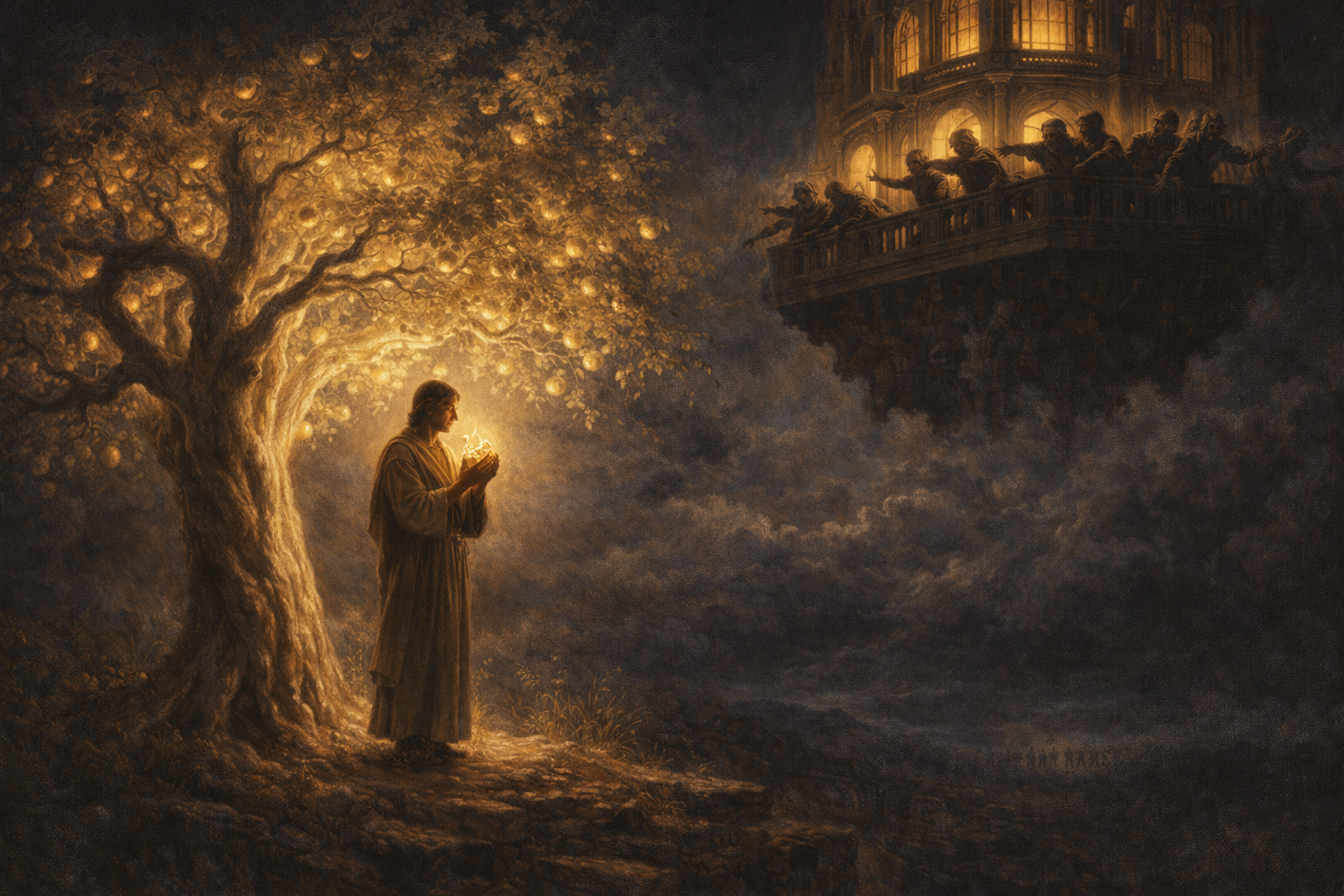
There is a scene in Lehi's vision that I cannot get out of my mind. He sees people press forward through the mists of darkness, hold fast to the iron rod, and reach the tree of life. They taste the fruit. It is real. It is sweet. They have a genuine experience with the things of God. By any reasonable measure, these people have testimonies.
Then the mocking starts. The great and spacious building erupts with laughter and pointing fingers. And some of the people who had just tasted the fruit look over their shoulder, feel the weight of that ridicule, and walk away.
They did not lose their testimony because someone out-argued them. They walked away because they could not bear being laughed at. The crowd's opinion mattered more than the fruit they had just eaten. And when those two things came into conflict, the crowd won.
That is the thing I want to talk about. Because what those people were missing was not a stronger testimony. It was something deeper than testimony. It was a transformation that never fully happened.
Knowing, Doing, and Being
The gospel calls us to three things, and most of the teaching we receive covers only the first two.
Knowing: that the Church is true, that Jesus is the Christ, that the Book of Mormon is the word of God. This is where testimony lives, and it is absolutely required. Without it, nothing else holds.
Doing: keeping the commandments, fulfilling callings, paying tithing, attending the temple, serving others. This is where faithfulness lives, and it matters deeply.
But there is a third level that the scriptures speak about more plainly than we often acknowledge. Being. Not knowing about Christ. Not doing what Christ taught. Actually becoming like Him. Having His image engraved in your countenance. Having the Holy Ghost as your constant companion, not as a periodic visitor but as a permanent presence that shapes who you are from the inside out.
Alma asked his congregation a question that still cuts straight through me when I read it slowly:
"And now behold, I ask of you, my brethren of the church, have ye spiritually been born of God? Have ye received his image in your countenances? Have ye experienced this mighty change in your hearts?"
(Alma 5:14)
He was not asking a congregation of investigators. He was asking people who were already members of the Church, people who had been baptized and confirmed and were attending their meetings. He was asking: has the transformation actually happened? Have you received His image? Not His knowledge. His image. His character, pressed into you until it shows on your face.
That is a different question than "do you have a testimony?" And I believe it is the question that the coming test is going to answer for every one of us, whether we want it answered or not.
"The test is not whether you know the gospel. The test is whether the gospel has changed you enough that the crowd's laughter has no power over you."
The Question Asked in Liberty Jail
In Doctrine and Covenants 121, the Lord speaks to Joseph Smith from the depths of Liberty Jail and makes him one of the most beautiful promises in all of scripture. If you let virtue garnish your thoughts unceasingly, He tells him, the Holy Ghost shall be your constant companion, and your scepter an unchanging scepter of righteousness and truth. Your dominion shall be an everlasting dominion, and without compulsory means it shall flow unto you forever and ever.
That promise was given to a man sitting in filth and cold, separated from his family, imprisoned by enemies, after months of suffering that most of us cannot imagine. The promise was not given in spite of the suffering. It was given in the middle of it. The being that the Lord was describing, the man with the constant companion and the unchanging scepter, is a man who has been forged in exactly the kind of fire Joseph was sitting in.
Then, in the very next chapter, the Lord asks Joseph the question that I think about more than almost any other verse in scripture. He walks him through a list of things that might happen to him. Betrayal by friends. False accusations. The stripping away of everything he built. His children threatened. His enemies triumphant. And then He asks:
"The Son of Man hath descended below them all. Art thou greater than he?"
(D&C 122:8)
No one is greater than Jesus Christ. And no one who truly wants to become like Him should be surprised when the path to that likeness passes through suffering, ridicule, and public contempt. Christ was mocked in a way that is almost impossible to fully comprehend. Not by strangers in passing. By the religious leaders of His own people. By the crowds He had fed and healed. By men who used the scriptures He fulfilled as the basis for His execution. They spat on Him. They put a crown of thorns on His head and laughed. None of it moved Him from His course. Not one inch. Not because He had a stronger testimony than His disciples, but because He had no part of Himself that still needed the crowd's approval.
The Lord described His work in us the same way Malachi described a refiner sitting over silver. He does not leave the fire until He sees His own image in the surface. That is what is happening when trials come. That is what suffering is for. Not punishment. Refinement. And the image He is waiting to see is His own.
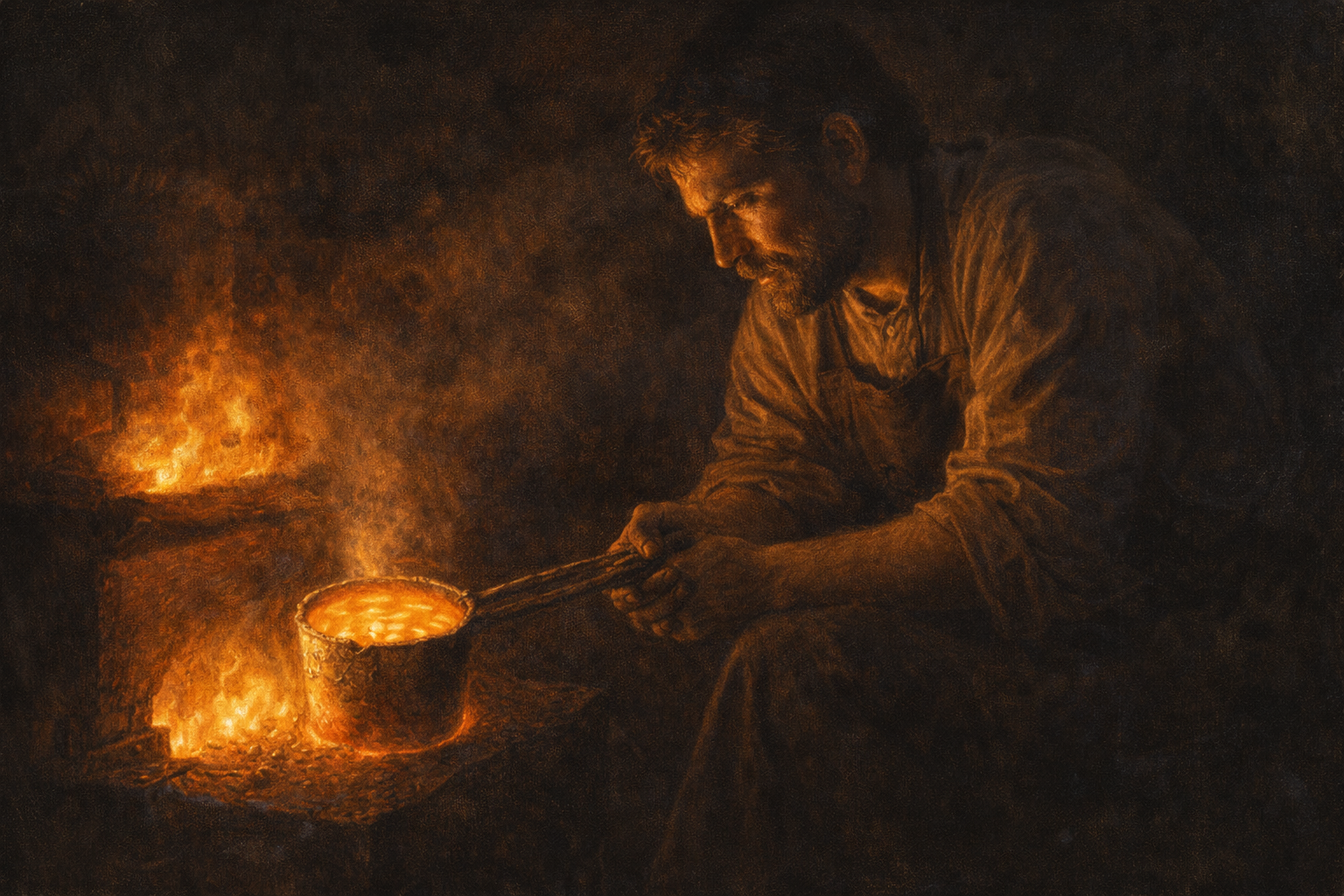
That is what we are being invited to become. Not just to know more, and not just to do more, but to be more. To be like Him. Paul said of Christ Himself: "Though he were a Son, yet learned he obedience by the things which he suffered." If it was true of the Son of God, it is true of every one of us.
What Is Coming, and Why It Will Expose Everything
I have spent years studying the scriptural case that Donald Trump is the latter-day servant described by Isaiah, identified by Christ in Third Nephi, and elaborated upon by John the Revelator. I believe the evidence is compelling, and I have laid it out in full in my book. But I am not going to rehearse all of it here.
What I want to say plainly is this: I believe Donald Trump is going to be converted to The Church of Jesus Christ of Latter-day Saints and will be called to a significant leadership position within it. When that happens, the decade of sustained mockery that has been heaped upon him will not stay focused on him. It will transfer to the Church. It will transfer to every member who chooses to stay.
Every late-night punchline, every contemptuous news segment, every social media post dripping with scorn, all of it will be redirected at you, your building, your ward, your family, and everything you hold sacred. The great and spacious building is about to point its fingers directly at anyone who stays in this Church and accepts what God is doing.
And that is when Lehi's vision becomes personal. Not as a story you know. As an experience you are living through.
I have watched people I respect deeply tell me, with real emotion, how much they despise this man. Members of the covenant. Temple-worthy. Faithful by every outward measure. And when I consider what is coming, I think about those conversations often. Because when the mocking arrives, the question it will answer is not whether they have a testimony. It is whether the transformation happened. It is whether there is something in them that still needs the building's approval.
If there is, the mocking will find it. That is what mocking does. It does not argue. It does not present evidence. It simply makes you feel foolish for believing what you believe, and it keeps applying that pressure until you break or until you discover there is nothing left in you to break. I have written at length about what hatred does to our ability to see clearly, and about how our beliefs filter everything we are willing to accept. But mocking goes deeper than both of those. It does not need to get past your reasoning. It bypasses reasoning entirely and goes straight for your need to belong.
"The people who fell away from the tree of life did not lose an argument. They lost a contest of belonging. The crowd was louder than the Spirit, and they had never been transformed enough for that not to matter."
There Is Still Time to Become
I am not writing this to frighten you. I am writing it because there is still time. The transformation the Lord is asking for does not happen the moment the trial arrives. It has to be built beforehand, through years of prayer, repentance, suffering accepted willingly, and the daily, deliberate work of letting God change not just what you know or what you do but who you actually are.
Moroni was direct about what that transformation looks like and what it requires:
"And except ye have charity ye can in nowise be saved in the kingdom of God; neither can ye be saved in the kingdom of God if ye have not faith; neither can ye if ye have no hope."
(Moroni 10:21)
Charity, the pure love of Christ, is the character trait that does not seek its own, that bears all things, that endures all things. It is the thing in a person that makes the crowd's opinion genuinely irrelevant, not through pride or stubbornness but through a love so complete and so oriented toward God that the building's laughter simply has nowhere to land.
If you want the full picture of what I believe is coming and why I believe it will be the defining test of this generation, it is in the book. Chapter 12 goes into this at length. The scriptural case for Donald Trump's role, the pattern of falling away the prophets saw, and what it will take to stand when everything around you is telling you to walk away. The book is called The First Horseman: Donald Trump and Biblical Prophecy, and I would ask you to read it before the events arrive, not after. After may be too late to grow the tree.
Kelly Smith is the author of The First Horseman: Donald Trump and Biblical Prophecy. He is a lifelong student of scripture and a member of The Church of Jesus Christ of Latter-day Saints.