Revelation • Scripture
The Hidden Structure of Revelation That Most Interpreters Have Missed
The Book of Revelation is not a random sequence of disasters. It is organized around a single central verse — and once you see that structure, the entire book opens up in ways that are breathtaking.
By Kelly Smith
Most people who try to read the Book of Revelation give up somewhere around chapter eight. The seals open. The trumpets sound. Disasters pile on top of disasters. Locusts with scorpion tails torment humanity for five months. A third of mankind dies. The sun turns black. And it is tempting to conclude that John simply recorded a terrifying sequence of catastrophes with no discernible organizing principle — a vision so chaotic and symbolic that its meaning is permanently beyond reach.
That conclusion is understandable. It is also completely wrong.
The Book of Revelation is one of the most precisely structured documents in all of scripture. It is organized according to an ancient Hebrew literary pattern called chiasmus — a pattern that appears throughout the Old Testament, throughout the Book of Mormon, and throughout the most sacred and inspired texts in human history. Once you understand this structure, the chaos disappears. The sequence becomes clear. And the entire book reveals itself to be not primarily about destruction at all, but about something far more glorious.
What Is Chiasmus?
Chiasmus is an ancient literary structure where ideas are presented in sequence and then mirrored in reverse, creating a pattern that looks like this:
A → B → C → D → CENTER → D' → C' → B' → A'
In this structure, A and A' mirror each other. B and B' mirror each other. Each matching pair is meant to be read together, with each element illuminating the other. And the center — the point where the structure pivots — carries the greatest weight. It is the most important element in the entire composition.
This is not a human literary device invented for stylistic effect. It is the language God consistently uses when conveying layered prophetic meaning through His servants. It appears in Psalm 22. It appears in Isaiah. It appears throughout the Book of Mormon — most famously in Alma chapter 36, where Alma recounts his conversion experience and places Jesus Christ at the very center. It appears in Christ's own teachings in 3 Nephi, where His prophecies about the last days are built as an extended chiasm with a single verse at the focal point.
And it appears, in its grandest form, throughout all twenty-two chapters of the Book of Revelation.
The Grand Structure of Revelation
When you lay out all twenty-two chapters of Revelation according to their chiastic relationships, a precise and beautiful structure emerges. The outer frame — chapters one through three at the opening and chapters twenty-one through twenty-two at the close — mirrors perfectly. The letters to the seven churches describe promises made to the overcomers. The New Jerusalem at the end describes those same promises fulfilled. Beginning and ending mirror each other exactly.
Moving inward, the throne room visions of chapters four and five mirror the throne visions and final judgment of chapters nineteen and twenty. The six seals of chapter six mirror the fall of Babylon in chapters seventeen and eighteen. The 144,000 sealed in chapter seven mirror the 144,000 victorious with the Lamb in chapters fourteen and fifteen. The seven trumpets of chapters eight and nine mirror the seven vials of chapters fifteen and sixteen. The two witnesses of chapters ten and eleven mirror the two beasts of chapter thirteen.
Each pair illuminates the other. The seven trumpets and seven vials, for example, are not fourteen separate judgments falling in chronological sequence — they are the same seven judgments described twice, from two different perspectives. The trumpets emphasize the warning aspect. The vials emphasize the completeness of the outpouring. Understanding this cuts the apparent timeline in half and resolves some of the most confusing interpretive problems readers have wrestled with for centuries.
But the most important revelation this structure provides is its center point.
The Verse at the Center of Everything
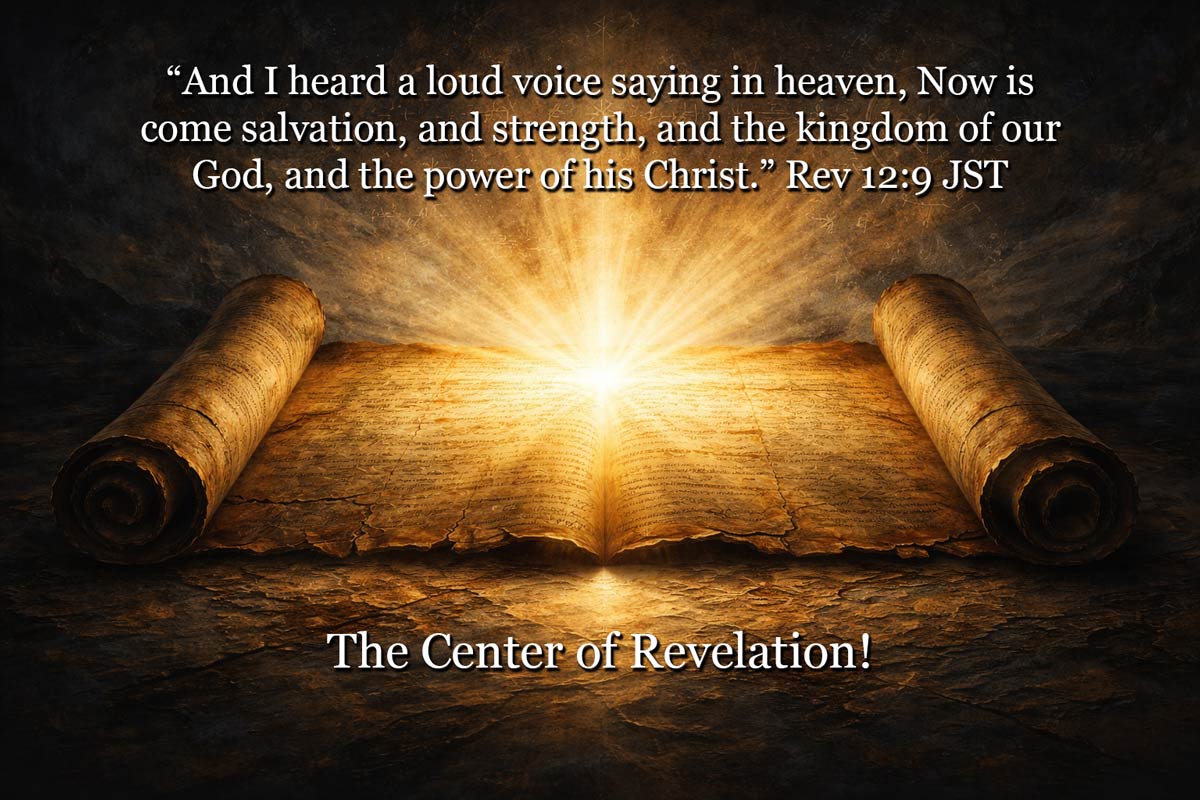
At the precise center of Revelation's chiastic structure stands chapter twelve. Everything in chapters one through eleven moves toward this chapter. Everything in chapters thirteen through twenty-two flows from it. And the verse at the center of chapter twelve — the center of the center — is this:
"And I heard a loud voice saying in heaven, Now is come salvation, and strength, and the kingdom of our God, and the power of his Christ: for the accuser of our brethren is cast down." (Revelation 12:10, JST 12:9)
This is the hinge upon which all of Revelation turns. This is what the entire book has been building toward and what everything that follows flows from. And when you grasp what it is actually declaring, the book transforms completely.
Revelation is not primarily about destruction. It is about the establishment of God's Kingdom on earth. The destructions happen because the Kingdom is established. The judgments fall because the righteous are being protected. The beasts rage because they are losing power. Every seal, trumpet, vial, and vision exists in relation to this one central truth: the Kingdom of God comes forth, and the accuser is cast down.
When readers approach Revelation as a chronological list of calamities, they miss the message entirely. When they recognize the chiastic structure with the Kingdom at its center, suddenly everything falls into place. The sequence becomes intelligible. The purpose becomes clear. And a book that seemed like an impenetrable wall of symbolism becomes a coherent, urgent, and deeply personal message to the people living in the last days.
Why This Changes Everything
Understanding the chiastic center of Revelation answers questions that have divided interpreters for generations. It explains why the seals, trumpets, and vials seem to overlap rather than proceed in neat sequence — because they are not a linear timeline but a layered structure circling a central event. It explains why chapter twelve feels like such a dramatic pivot in the narrative — because structurally it is. It explains why the establishment of the Kingdom and the casting down of the accuser belong together in the same verse — because they are the same event seen from two perspectives simultaneously.
It also explains what scripture reveals about Trump's specific role in the prophetic events of the last days. The First Horseman of Revelation rides at the opening of the first seal. And the first seal, properly understood, is not a judgment. It is the pivotal event that sets every other event in motion — the moment when the Kingdom of God comes forth in power and the entire sequence John described begins to unfold.
The chiastic structure also illuminates what kind of event we should be watching for. In Hebrew literary tradition, the center of a chiasm always contains the most important element. God placed the establishment of His Kingdom at the center of Revelation for the same reason Alma placed Jesus Christ at the center of his conversion narrative — because that is the point around which everything else in the story revolves. When that central event occurs, every matching element in the structure will begin to find its fulfillment.
The Structure Is Its Own Witness
One of the most powerful implications of Revelation's chiastic structure is what it tells us about the origin of the book itself. Only God could structure a prophetic text with this level of intricate symmetry while simultaneously encoding future events across its entire length. No human author composing visions from imagination could produce a document where every element finds its precise mirror and where the most important truth of all sits at the mathematical center.
The structure is itself a testimony. John did not compose these visions. He received them from a Being who sees the end from the beginning, who speaks in perfect symmetry because His works are perfect. The fact that the chiastic pattern holds across all twenty-two chapters — a pattern John could not have planned consciously while experiencing visions — is one of the most compelling evidences of divine inspiration in the entire canon of scripture.
And when that divinely structured document places the establishment of God's Kingdom at its very center, it is telling us something about the purpose of everything else in the book. The judgments are not the story. They are the context. The story is the Kingdom. And understanding who the Davidic servant is and what role he plays in the Kingdom's establishment is the key that unlocks what Revelation has been trying to tell us all along.
We are not waiting for the end of the world. We are waiting for the beginning of the Kingdom. Those are very different things. And the difference between them is the difference between fear and preparation, between confusion and clarity, between watching events unfold with dread and watching them unfold with understanding.
The Book of Revelation was never meant to be terrifying to those who understand it. It was meant to be a road map. The structure God built into it is the key — and the key has been there the entire time, waiting for those with eyes to see it.
The Full Prophetic Picture
The chiastic structure of Revelation is one of several interpretive keys examined in my book, The First Horseman: God's Chosen Servant. The book walks through the complete structure chapter by chapter, identifies the central event that opens the first seal, and explains what every believer needs to understand about the times we are living in right now.
Kelly Smith is the author of The First Horseman: God's Chosen Servant. He is a lifelong student of biblical prophecy and a member of The Church of Jesus Christ of Latter-day Saints.
Privacy Policy | Terms of Service
© 2026 Kelly Smith. All rights reserved.
This work represents personal spiritual insights and scriptural interpretations. All sales are final for digital products due to immediate access.
This site is not a part of the Facebook website or Facebook Inc. Additionally, this site is not endorsed by Facebook, Google, or any other platform in any way. Facebook is a trademark of Meta Platforms, Inc. Google is a trademark of Google LLC.