Every generation looks at the gap between rich and poor, shakes its head, and concludes that someone needs to do something about it. The anger is completely understandable. When two or three percent of the world's population earns more than the remaining billions combined, something is clearly broken. When children sleep in cardboard shelters three blocks from a building with gold fixtures in the lobby, something is wrong. We all feel it. We have always felt it. And here is the part most people do not stop to consider: that feeling goes back a lot further than any economic theory.
It goes all the way back to before this world was created.
The Oldest Argument in Existence
In our premortal life, Lucifer was not some shadowy figure lurking in the corners of heaven. He was a being of light and authority who knew God the Father personally. His name literally means "light bearer." And what did he do with all of that standing? He launched a campaign built on the most emotionally powerful argument imaginable: fairness. Why should some be exalted above others? Why should anyone be permitted to fail when we could simply guarantee that everyone succeeds?
It sounded reasonable. It probably sounded compassionate. And it was a lie from the beginning, wrapped in the oldest packaging he has ever used.
A third of the host of heaven followed him. Stop and sit with that number for a moment. These were not ignorant souls. These were our brothers and sisters who had lived in God's presence, who had heard His voice, who understood the plan of salvation. And the appeal to fairness and equality was enough to drag them out of their eternal future.
I cannot think about that without feeling the weight of it. And I believe God felt it in a way we cannot fully comprehend, because we know that God weeps. In the book of Moses, the prophet Enoch has a vision and sees something that stops him completely. He sees God weeping. It startles him so deeply that he asks what could possibly cause the God of creation to shed tears over His children. The Lord's answer is one of the most breathtaking passages in all of scripture:
"Behold these thy brethren; they are the workmanship of mine own hands, and I gave unto them their knowledge, in the day I created them; and in the Garden of Eden, gave I unto man his agency. And unto thy brethren have I said, and also given commandment, that they should love one another, and that they should choose me, their Father; but behold, they are without affection, and they hate their own blood." (Moses 7:32–33)
God weeps because He knows what His children are giving up. He sees the end from the beginning. He understands what they could have become. Most people carry a picture of God as a being so exalted that nothing could disturb His perfect serenity. That picture is incomplete. He is the most loving Father who has ever existed, and the loss of His children breaks His heart.
I say all of this because the conversation we are about to have about wealth, poverty, and economic fairness is not merely a political conversation. It is a deeply spiritual one. It always has been. And if we approach it without understanding what God actually thinks about it, we will keep arriving at the same wrong answers that humanity has cycled through for six thousand years.
Four Systems, Four Failures
Every major economic system in history has been an attempt to solve the fairness problem. All of them, in the end, have fallen short.
Communism is the most obvious failure. It promises perfect equality and delivers something that looks nothing like it. The moment you remove private property and place all resources in the hands of a central authority, you have not eliminated the powerful few. You have simply changed who they are. The history of communist regimes is not a history of shared prosperity. It is a history of tyranny, starvation, and hundreds of millions of preventable deaths. And yet the idea keeps coming back, dressed in new clothes every few decades, because the promise of fairness never loses its emotional pull.
Socialism and Marxism are variations on the same theme. You cannot legislate righteousness into a population that has not chosen it. You can only create compliance, and compliance maintained by force will eventually produce the same tyranny every time.
Capitalism has lifted more people out of poverty than all three of the others combined. That is simply true. The freedom to own property, to build something and keep the results of your effort, to compete and innovate without government deciding in advance who wins, has created more widespread material prosperity than any other system in history. But capitalism is not just. It rewards ambition without requiring conscience. It allows a single person to accumulate wealth measured in the hundreds of billions while people who work themselves to exhaustion cannot afford a doctor's visit.
And here is what God said about it, through the Prophet Joseph Smith:
"But it is not given that one man should possess that which is above another, wherefore the world lieth in sin." (D&C 49:20)
That is a startling statement. Flat and unambiguous. On the surface it sounds like a divine endorsement of communism. But it is not. It is something entirely different — something no earthly political philosophy has ever successfully imitated, though they have all tried.
The Only System That Has Ever Worked
In all of recorded human history, there have been exactly three societies that solved the fairness problem completely. Three. Not three hundred. Three.
The City of Enoch. The City of Melchizedek. And the period of approximately two hundred years that followed the appearance of Jesus Christ to the Nephites and Lamanites in the Americas. In each case, the result was so astonishing that the word used to describe these societies is the same: Zion.
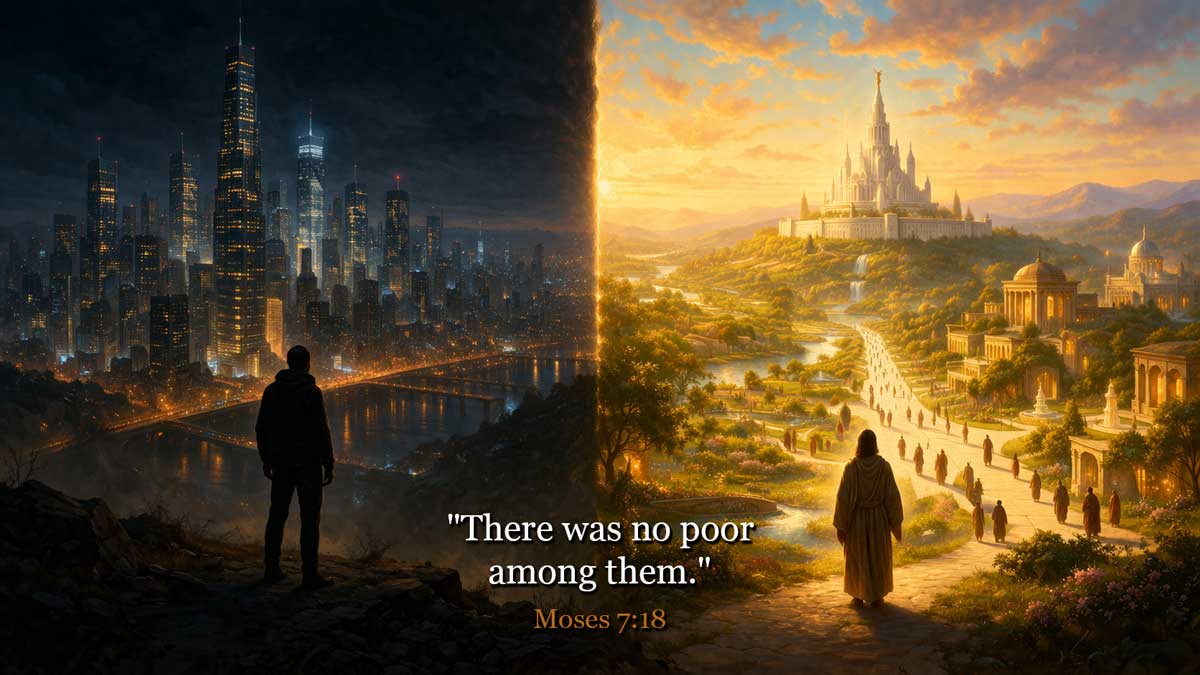
"And the Lord called his people Zion, because they were of one heart and one mind, and dwelt in righteousness; and there was no poor among them." (Moses 7:18)
No poor among them. Not "fewer poor." Not "a reduced poverty rate." No poor. That outcome is so foreign to every society that has ever existed that most people read it as poetic language. But it was real. Both the City of Enoch and the City of Melchizedek became so thoroughly righteous that God took them into His presence entirely, city and all.
The Nephite and Lamanite civilization after Christ's visit lasted nearly two centuries before pride crept back in. The Book of Mormon describes those two hundred years with language that should make every reader stop:
"And there were no envyings, nor strifes, nor tumults, nor whoredoms, nor lyings, nor murders, nor any manner of lasciviousness; and surely there could not be a happier people among all the people who had been created by the hand of God." (4 Nephi 1:16)
The happiest people who had ever lived. And that result did not come from a new economic policy imposed by a government. It came from righteousness. That is the one ingredient every other system leaves out — the ingredient nobody wants to talk about, because it requires something of every individual that most people are not prepared to give.
The Idol Problem We Will Not Admit
The Law of Consecration requires you to stop wanting more than your neighbor has. It requires you to find your identity and security in something other than what you own. It requires the very thing that every clever marketing system in the world is working twenty-four hours a day to destroy in you.
We live in the most thoroughly idolatrous civilization that has ever existed on this planet. I realize that is a bold claim. When ancient Israel bowed down to a golden calf in the wilderness, the offense was not that the calf was beautiful. The offense was that they were bowing their hearts to an object of their own making rather than to God.
Now tell me what is happening when a person sits for hours consuming content built entirely around the most expensive watches, the fastest cars that only the wealthiest rulers on earth can afford, the most extravagant mansions. What is that, if not the worship of the workmanship of human hands? If I told someone they had an idol they were bowing to every time they pulled up that content on their phone, they would laugh at me. But the gods of metal, glass, carbon fiber, and computer screens are still gods in the only sense that matters: they are the things we orient our desires around, the things that tell us what success looks like. They have nothing to do with God.
The Law of Consecration does not ask you to be poor. It asks you to be a steward rather than an owner, to recognize that the land and resources and abilities you have been given are God's gifts held in trust, not possessions to be accumulated and displayed. The result of that shift, in every society that achieved it, was that there was no poor among them.
Why Joseph Smith's Attempt Failed, and What Comes Next
God tried to establish the Law of Consecration through the Prophet Joseph Smith. He tried multiple times, and every attempt eventually ran into the same wall: the people were not ready. The Lord's assessment of His own people at the time was sobering:
"They have not learned to be obedient to the things which I required at their hands, but are full of all manner of evil, and do not impart of their substance, as becometh saints, to the poor and afflicted among them; And are not united according to the union required by the law of the celestial kingdom; And Zion cannot be built up unless it is by the principles of the law of the celestial kingdom; otherwise I cannot receive her unto myself." (D&C 105:3–5)
Zion cannot be built up unless it is by the principles of the law of the celestial kingdom. Not telestial half-measures. The celestial standard. That is the only foundation on which Zion has ever stood.
Are we stuck cycling through the same broken systems forever? We are not. God's Kingdom has four aspects — ecclesiastical, political, economic, and social — and the Law of Consecration is the economic aspect that has been dormant since Joseph Smith's day. Understanding the full role of the Davidic servant in restoring all four aspects is essential context here.
I am aware of how strange what I am about to say will sound to many readers. The man who is going to play a central role in establishing the only economic system that has ever actually worked is a billionaire real estate developer whose buildings are famously covered in gold. Go ahead and laugh. I understand the reaction completely.
But consider this: who in the world would be better equipped to design and implement a functional economic system for a holy city than someone who has spent his entire career building things, negotiating property rights, managing enormous resources, and navigating the full complexity of what it takes to create something from nothing? The Law of Consecration is built on private property that cannot be taken away from its steward. It requires careful, skilled management of land and resources. God rarely picks the obvious candidate. He picked a shepherd boy to be Israel's greatest king. He picked a young man from upstate New York to restore the fulness of the gospel. The pattern of God choosing the unexpected deliverer runs throughout all of scripture.
Isaiah saw the kings of the earth respond to this message in a way that has always intrigued me. They shut their mouths. Kings do not shut their mouths when they hear something ordinary. They shut their mouths when they hear something they have never considered — something so different from everything they have been offered that the only response, at least for a moment, is silence.
The world has been arguing about four broken systems for centuries. The answer is not a fifth system. It is the only one that has ever worked, made possible by a level of righteousness that the world cannot produce on its own but that God, through His servants, is preparing His people to live. That preparation begins now, in our own hearts, long before any of the institutions around us have caught up. And that is exactly where God intends for it to start. For more on what these events look like in their full prophetic sequence, the article on Donald Trump in biblical prophecy lays the broader framework out clearly.
Kelly Smith is the author of The First Horseman: Donald Trump and Biblical Prophecy. He is a lifelong student of biblical prophecy and a member of The Church of Jesus Christ of Latter-day Saints.