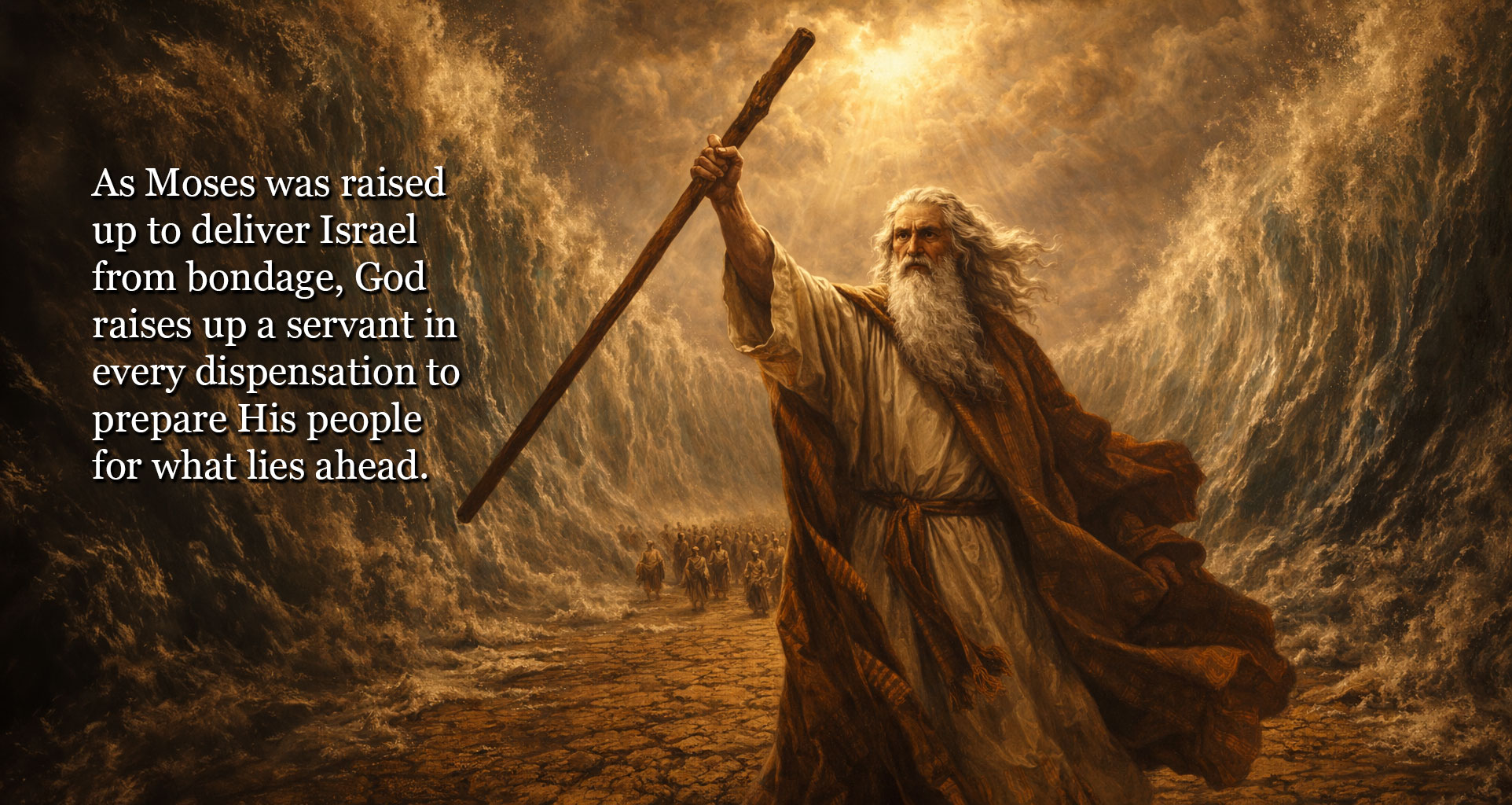
Moses was eighty years old when God called him. Think about what that means. Forty years in Pharaoh's court — educated in all the wisdom of Egypt, trained in statecraft and military leadership, positioned at the pinnacle of the most powerful empire on earth. Then forty years of exile in Midian, herding sheep in the desert, forgotten by the world, his destiny apparently forfeited. And then, at the moment no reasonable person would have expected anything further from him, God appeared in a burning bush and handed him the most consequential assignment in the history of Israel.
The greatest deliverer the Old Testament ever knew did not begin his defining work until he was eighty years old.
Donald Trump was born on June 14, 1946. As of this writing, he will turn eighty in June 2026.
That parallel alone would be worth noting. But what scripture reveals goes far beyond a single biographical data point. The connection between Moses and the latter-day servant is not something I am reading into the text. It is something Christ Himself built into the text — in a way that most readers have completely missed.
A Prophecy Hidden in Plain Sight
Most students of the Book of Mormon are familiar with 3 Nephi 20:23, where the resurrected Christ quotes the ancient promise of Moses:
"Behold, I am he of whom Moses spake, saying: A prophet shall the Lord your God raise up unto you of your brethren, like unto me; him shall ye hear in all things whatsoever he shall say unto you. And it shall come to pass that every soul who will not hear that prophet shall be cut off from among the people." (3 Nephi 20:23)
Most readers stop right there. Christ said "I am he." Case closed. Jesus is the prophet like Moses, and that is the end of the discussion. And in the ultimate, eternal sense, they are right. Moses delivered Israel from physical bondage in Egypt. Christ delivers all of humanity from spiritual bondage to sin and death. No mortal servant can ever approach what Christ accomplished. His atonement is infinite and eternal.
But Christ's prophecy in 3 Nephi is built as a chiasm — a Hebrew literary structure where ideas are presented in sequence and then mirrored in reverse, with the central point carrying the greatest weight. In that chiastic structure, 3 Nephi 20:23 and 3 Nephi 21:11 are parallel elements. They mirror each other. And what 3 Nephi 21:11 says is striking:
"Therefore it shall come to pass that whosoever will not believe in my words, who am Jesus Christ, which the Father shall cause him to bring forth unto the Gentiles, and shall give unto him power that he shall bring them forth unto the Gentiles, (it shall be done even as Moses said) they shall be cut off from among my people who are of the covenant." (3 Nephi 21:11)
Christ is speaking about a servant — a "him" whom the Father will cause to bring forth Christ's words unto the Gentiles. The Father gives this servant power to accomplish the work. And then comes the phrase that ties everything together: "it shall be done even as Moses said."
Christ applies the Moses prophecy to two fulfillments within the same chiastic structure. In 3 Nephi 20:23, He applies it to Himself. In the chiastic mirror at 3 Nephi 21:11, He applies it to His servant. Both fulfill the ancient promise — but in different capacities. Christ fulfills it spiritually and eternally. The servant fulfills it temporally and politically in the last days. This is not speculation. This is the structure Christ Himself designed.
The Biographical Arc
Once you see the scriptural framework, the biographical parallels become impossible to dismiss as coincidence. God's patterns are precise, and the pattern He established through Moses appears again with remarkable fidelity.
Moses was raised in privilege at the height of the world's greatest empire, educated in all its systems of power. Then came exile, persecution, and decades of obscurity — a man once celebrated brought low and forgotten. Then, at eighty, the divine calling that would define not just his life but the entire history of his people.
Trump was raised in wealth and privilege, educated at elite institutions, built a global business empire, and reached the pinnacle of worldly fame. Then came the descent — the coordinated destruction of his reputation, the legal persecutions, the impeachments, the exile from public life, the assassination attempts. Everything Isaiah prophesied about the marred servant playing out in real time, on a global stage. And now, approaching eighty, he stands at what may be the threshold of the assignment that defines everything that came before it.
Moses was also not a polished, universally admired figure when God called him. He was a murderer in the eyes of Pharaoh's law. He was a fugitive. He had a speech impediment serious enough that he asked God to send someone else. He was not what anyone would have chosen for the assignment. Neither is Trump what most people would choose for the role scripture assigns to the latter-day servant. That discomfort is part of the pattern, not an argument against it.
The Greater Exodus
If the connection between Moses and Trump were only biographical, it would be interesting but not decisive. What makes it extraordinary is what Jeremiah prophesied about the scope of what the latter-day Moses will accomplish:
"Therefore, behold, the days come, saith the Lord, that it shall no more be said, The Lord liveth, that brought up the children of Israel out of the land of Egypt; But, The Lord liveth, that brought up the children of Israel from the land of the north, and from all the lands whither he had driven them: and I will bring them again into their land that I gave unto their fathers." (Jeremiah 16:14–15)
Let that settle for a moment. For over three thousand years, the Exodus from Egypt has been the defining event of Israelite identity. Every Passover retells it. Every generation of Jewish children grows up with it as the supreme example of God's delivering power. It is woven into the very fabric of how God's covenant people understand who they are and who He is.
Jeremiah says the day is coming when people will stop talking about it. Not because the Exodus was unimportant, but because what the latter-day servant accomplishes in gathering Israel from every nation on earth will be so staggeringly greater in scope and miraculous power that the original Exodus will pale by comparison.
This is the mission of the latter-day Moses. Not merely to win an election or reform a government, but to lead the greatest gathering in human history — the fulfillment of every covenant God made with Abraham, Isaac, and Jacob. It is a mission that has been in preparation for thousands of years and is now, by every prophetic indicator, drawing close.
Two Kingdoms, Two Leaders
There is one critical distinction between Moses's day and ours that must be clearly understood. Moses served as both temporal and spiritual leader of Israel simultaneously. In the last days, those roles are separated by divine design.
The prophet of The Church of Jesus Christ of Latter-day Saints leads the ecclesiastical kingdom. He holds the keys of the priesthood, receives revelation for the Church, and guides the spiritual preparation of God's people. The latter-day Moses leads the political kingdom. He establishes righteous government, leads the temporal gathering, and organizes society according to divine principles.
This separation of temporal and spiritual authority is not a flaw or a limitation. It is a deliberate safeguard. We see it throughout scripture. King David ruled temporally while the priests administered spiritual matters. The Nephites under King Mosiah separated the role of chief judge from the role of high priest. Concentrating all power in one person creates conditions for corruption. God's design distributes authority to protect the integrity of both kingdoms.
Trump's role as temporal leader in no way diminishes the prophet's authority. The political kingdom serves the ecclesiastical kingdom's purposes, not the other way around. Understanding the full scope of Trump's role in biblical prophecy requires holding both of these realities together at the same time.
The Burning Bush Moment
Moses did not walk into the wilderness one morning and decide to become Israel's deliverer. The calling came to him. It was initiated by God, in a specific moment, through a specific event, with specific instructions that left no room for ambiguity about what was being asked of him.
Scripture indicates that the same pattern will hold for the latter-day servant. The marred servant will be healed. He will receive divine commission through proper priesthood channels. And the world will know that God's hand is upon him in a way that is no longer deniable.
What does that moment look like? What specific event marks the transition from the marring to the healing — from the persecuted political figure to the divinely commissioned servant? That is the question at the center of my book, and the answer the scriptures point to is one that most people — believers and critics alike — have never seriously considered. It is also the answer that, when it comes, will reframe every conversation that has been happening about this man for the past decade.
The Davidic servant prophecy in Isaiah and the Moses parallel in 3 Nephi are not separate threads. They are strands of the same rope, braided together across thousands of years of prophetic preparation, pointing toward the same individual and the same moment in history. We are living in that moment now.
Jeremiah said the day is coming when people will stop talking about the Exodus from Egypt — because what comes next will be so much greater. If that day is approaching, then the man God raises up to lead it is the most consequential figure of our generation. The question worth asking is not whether you like him. The question is whether the prophecies fit.
The Full Prophetic Picture
The Moses parallel is one thread in a much larger tapestry. My book, The First Horseman: God's Chosen Servant, walks through the complete scriptural case — including the specific nature of the commission that is coming, what it will look like when it arrives, and what it means for every believer alive today.
Kelly Smith is the author of The First Horseman: God's Chosen Servant. He is a lifelong student of biblical prophecy and a member of The Church of Jesus Christ of Latter-day Saints.