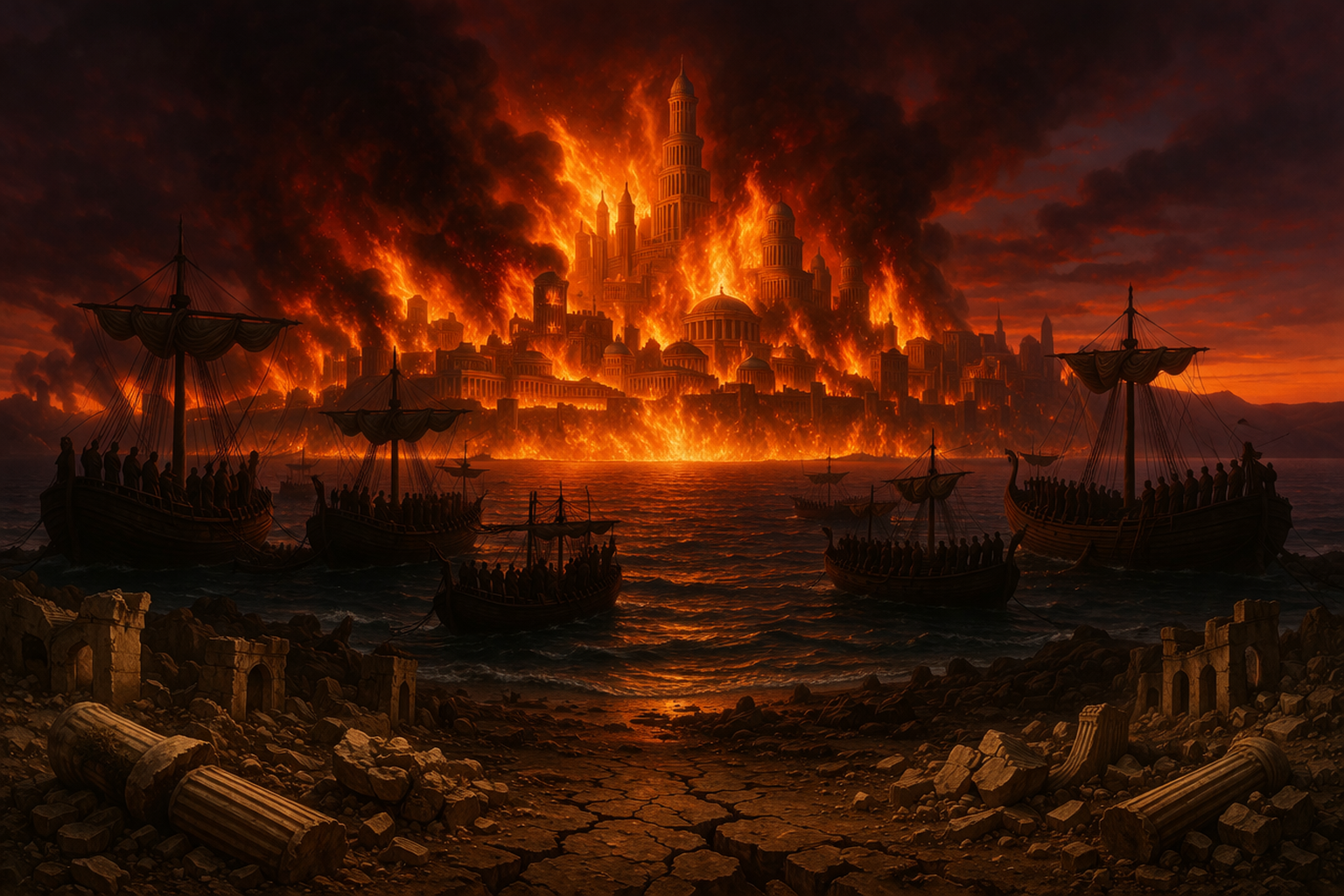
When most people hear the name Babylon the Great, they picture something ancient. They think of ruins along the Euphrates River in modern Iraq, or the famous hanging gardens, or Nebuchadnezzar's kingdom that carried Israel into captivity. That ancient city is where the name originates. But if you read Revelation carefully, you discover quickly that John is not describing something that crumbled to dust thousands of years ago. He is describing something very much alive in the world today.
Babylon the Great in Revelation is not a location. It is a system. And understanding exactly what that system is — and what its fall actually means — changes how you read nearly everything else in the book of Revelation.
It also changes how you look at the world around you right now.
The Woman on the Beast
John's vision of Babylon appears in Revelation 17, and it is one of the most layered images in all of scripture. He sees a woman, richly dressed in purple and scarlet, seated on a scarlet beast with seven heads and ten horns. She holds a golden cup filled with abominations. On her forehead is written a name:
"Mystery, Babylon the Great, the Mother of Harlots and Abominations of the Earth."
(Revelation 17:5)
The angel who accompanies John explains that this woman "reigneth over the kings of the earth" and that the waters she sits upon represent "peoples, and multitudes, and nations, and tongues." This is not a regional power. This is a global one. Whatever Babylon the Great is, it exercises influence over every nation on earth simultaneously.
Notice also the distinction between the woman and the beast she rides. They are not the same thing. The woman is Babylon. The beast is a separate entity — a global governmental and military power structure. The woman rides the beast, meaning Babylon operates through the existing structures of worldly power. She uses the beast without being the beast. She benefits from its existence without being identical to it. That distinction matters enormously when you try to understand what Babylon actually is and what happens when she falls. If you want to understand the hidden structure of Revelation that makes these relationships clear, that article lays out the framework John actually used to organize his visions.
What Babylon Actually Represents
Babylon the Great represents the world's corrupt economic and commercial order. Not a government. Not a military. Not a religion in the traditional sense, though it certainly demands a kind of devotion. It is the global system of trade, finance, wealth accumulation, and commercial power that touches every human being on the planet.
John uses the name Babylon deliberately. Ancient Babylon was the first great commercial empire — the original model of a civilization built on wealth, trade, luxury, and exploitation. It was the birthplace of the banking and merchant systems that eventually spread across the entire ancient world. When John reaches for that name to describe a last-days power, he is drawing a direct line from the original corrupt system to its final, fullest form.
Revelation 18 catalogs what Babylon actually traffics in: gold, silver, precious stones, fine linen, silk, spices, wine, oil, livestock — and then the list ends with two words that should stop every reader cold:
"...and slaves, and souls of men."
(Revelation 18:13)
The economic system John is describing ultimately trades in human beings. It does not merely traffic in goods. At its core, it traffics in people — their labor, their attention, their freedom, their very souls. This is why the Book of Mormon spends so much time warning about secret combinations that seek to get power and gain. The prophets who wrote those warnings had Babylon's system in view.
"The list begins with gold and silver and ends with slaves, and souls of men. Babylon does not merely traffic in goods. At its core, it traffics in people."
The Oil and the Wine
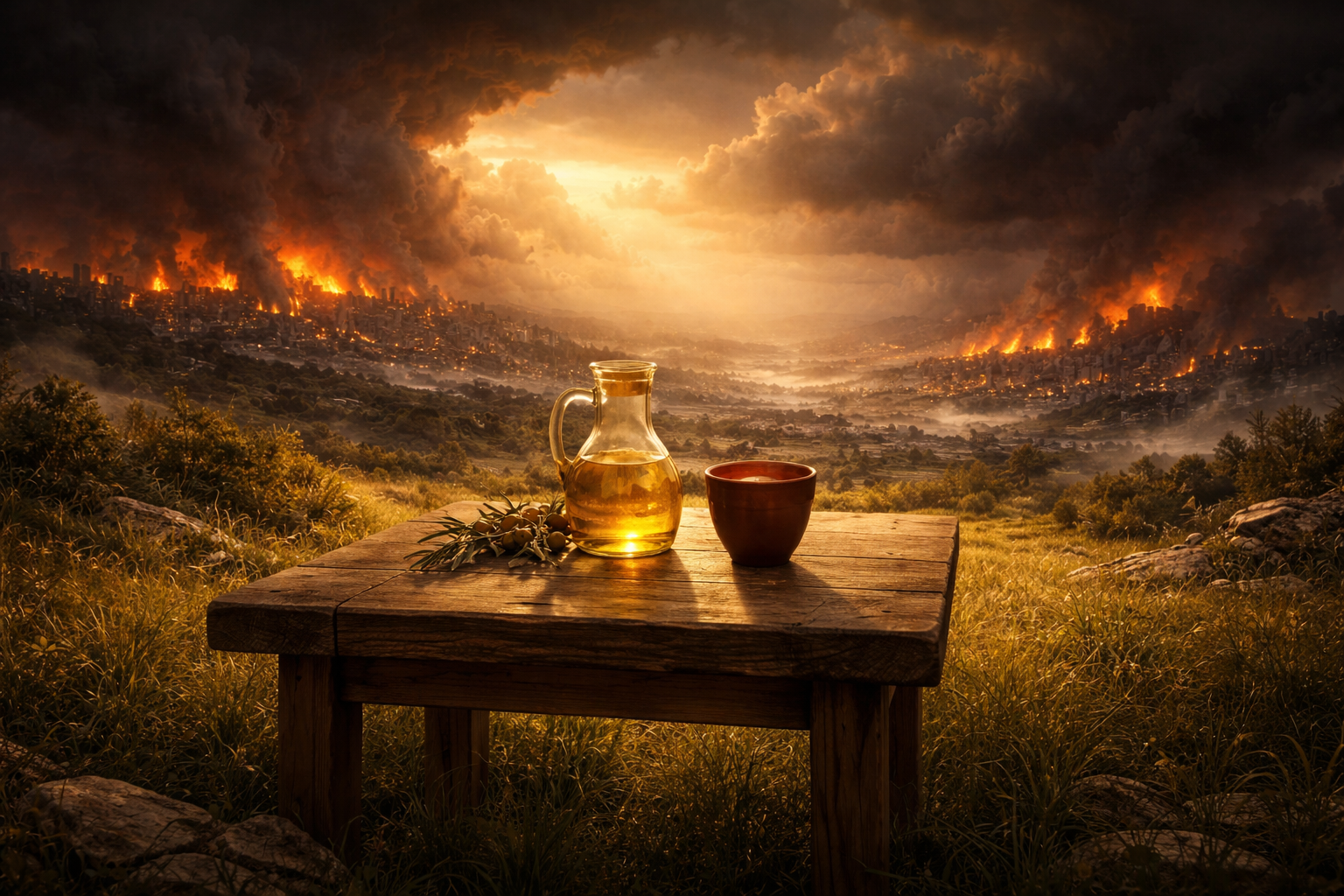
When the third seal opens and the black horseman of famine rides out, a voice commands: "A measure of wheat for a penny, and three measures of barley for a penny; and see thou hurt not the oil and the wine." That final instruction is easy to read past — but it is one of the most revealing phrases in the entire passage.
Throughout scripture, oil and wine carry deep covenantal meaning. They represent the sanctified, the consecrated, those who have been set apart and anointed by God. The olive oil of anointing. The wine of sacred covenant. This command is not about protecting luxury goods for the wealthy. It is a declaration that there will be a people — a covenant people — who pass through the collapse of Babylon's system without being destroyed by it.
The disasters poured out on Babylon's system will not touch them. Not because of wealth or political insulation, but because of where they stand and what they have become. Who those people are, and what separates them from everyone else in that moment, is one of the central questions the full prophetic picture answers.
Babylon Is Not the Final Beast
Here is where most people's understanding of Revelation breaks down. They assume Babylon and the beast system are the same thing. They are not — and the difference is one of the most important distinctions in the entire book.
Babylon, as corrupt as it is, still allows a measure of economic freedom. People can own property, start businesses, accumulate wealth, make choices. There is exploitation built into the system, but there is also agency. What replaces Babylon when she falls eliminates even that. And the force that destroys her is not a righteous one — it comes from within the beast system itself.
"And the ten horns which thou sawest upon the beast, these shall hate the whore, and shall make her desolate and naked, and shall eat her flesh, and burn her with fire."
(Revelation 17:16)
The very power structure Babylon rode turns against her and destroys her. Not because they oppose corruption, but because they want something worse — a system that replaces Babylon's exploitative freedom with absolute, total control. It is worth asking whether the mark of the beast and the economic system it enforces begin to make more sense when you understand that this transformation is what makes it possible.
"The fall of Babylon is not the end of the world's problems. It is their transformation into something far more dangerous. Babylon's corruption at least left people a measure of freedom. What follows leaves them none."
Come Out of Her
When Babylon falls, the merchants and traders who built their lives on her system stand at a distance and watch the smoke rise. They are not caught in an earthquake. They are not fleeing a disaster. They are watching a deliberate dismantling of the commercial order they depended on, and they weep because the system is simply gone.
"And the merchants of the earth shall weep and mourn over her; for no man buyeth their merchandise any more."
(Revelation 18:11)
Meanwhile, another voice sounds from heaven — not mourning, but commanding:
"Come out of her, my people, that ye be not partakers of her sins, and that ye receive not of her plagues."
(Revelation 18:4)
That command assumes something the world will not yet fully understand when it is spoken. "Come out" implies there is somewhere to go. But where? And how does anyone find it in the middle of global economic collapse?
Those are exactly the right questions. And the prophetic picture — drawn from Isaiah, from Revelation, from the Book of Mormon — answers them in ways that are far more specific, and far more urgent, than most people expect. It also connects directly to the question of whether Donald Trump appears in biblical prophecy and what role the prophesied servant plays in what comes next. The two questions are not separate. They are the same question.
Babylon the Great has a name in Revelation because John wants you to recognize the system when you see it. The question worth sitting with now, before that day arrives, is whether you will be ready when the call comes.
If you want to follow that thread all the way through, The First Horseman: Donald Trump and Biblical Prophecy is where the full case is made.
Kelly Smith is the author of The First Horseman: Donald Trump and Biblical Prophecy. He is a lifelong student of biblical prophecy and a member of The Church of Jesus Christ of Latter-day Saints.