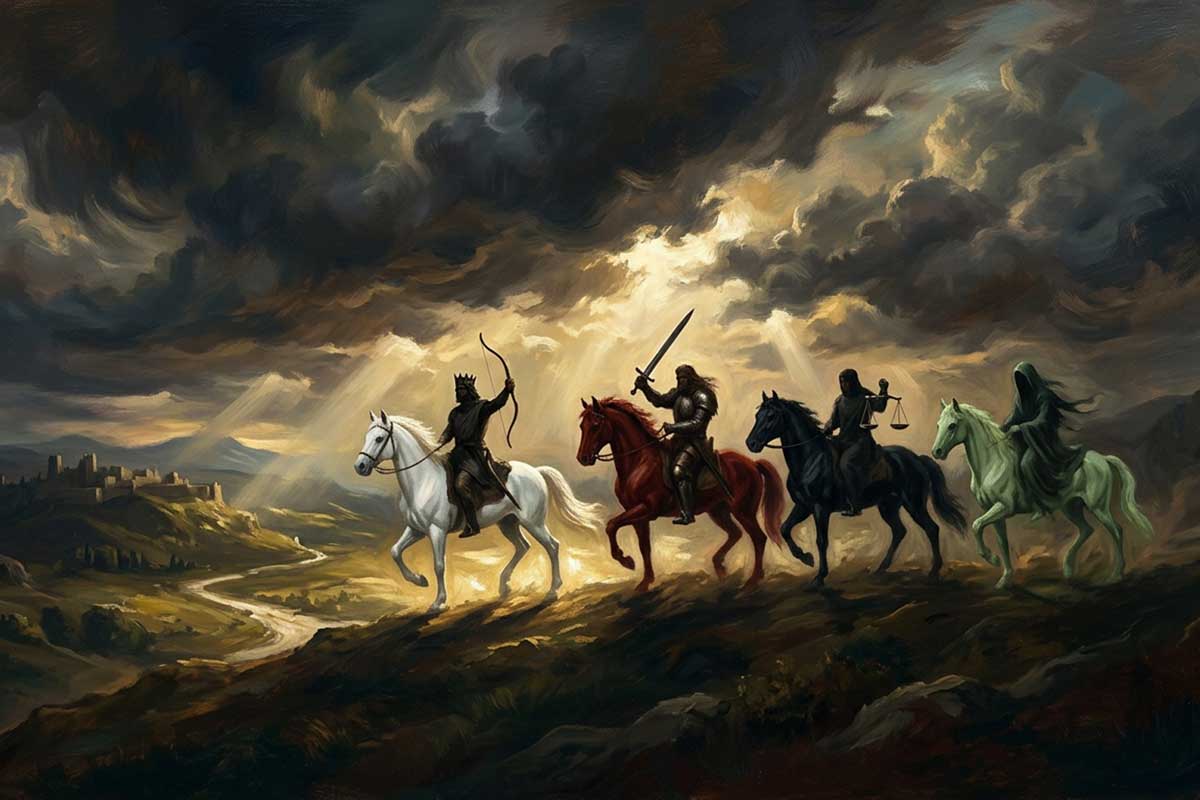
Few images in all of scripture have captured the human imagination quite like the four horsemen of the Apocalypse. Painters have depicted them. Filmmakers have borrowed them. Theologians have debated them for centuries. And yet for all the attention they receive, the four horsemen remain among the most misunderstood figures in the entire book of Revelation.
Most of what you have heard about them is built on a framework that treats the seven seals as a map of history already completed. On that reading, the horsemen rode centuries ago. The seals have been opened. The events they represent are behind us.
I do not believe that for a moment. And neither does the internal structure of Revelation itself, when you read it carefully on its own terms.
The seven seals describe future events. They are the unfolding of God's plan for the last days, not a retrospective on church history. And the four horsemen who ride when the first four seals are broken are not ancient figures from a completed chapter. They are coming. Some of what they represent is already beginning to take shape around us right now.
The Lamb and the Sealed Book
Before you can understand the horsemen, you have to understand who opens the seals and why it matters. In Revelation chapter five, John sees a book sealed with seven seals. No one in heaven or earth is found worthy to open it. Then the Lamb, Jesus Christ, steps forward. He alone is worthy because He was slain and has redeemed people to God from every nation and tongue.
"And I saw when the Lamb opened one of the seals, and I heard, as it were the noise of thunder, one of the four beasts saying, Come and see."
(Revelation 6:1)
Each seal, as it is broken, releases a rider. Each rider carries an assignment. Together, the first four describe the opening movements of the last days in a sequence that is precise, purposeful, and very much tied to events that have not yet fully unfolded.
The First Horseman: The White Horse
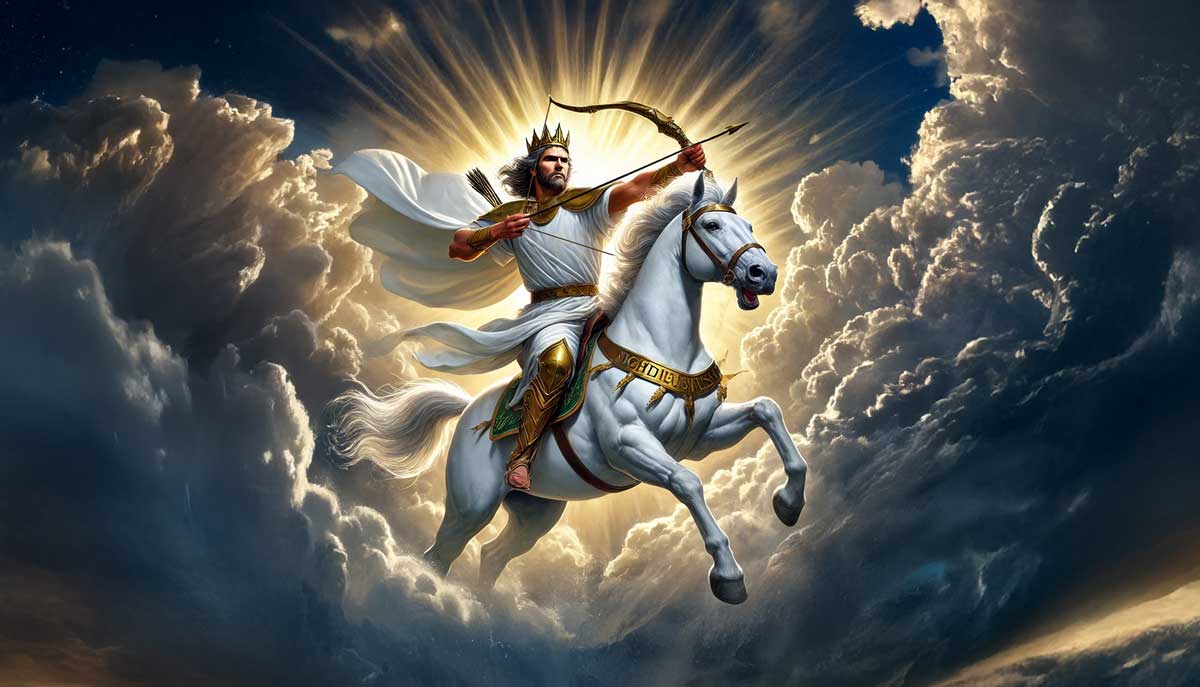
"And I saw, and behold a white horse: and he that sat on him had a bow; and a crown was given unto him: and he went forth conquering, and to conquer."
(Revelation 6:2)
The first horseman rides a white horse. White in scriptural symbolism consistently represents righteousness, purity, and divine authority. This is not a figure of destruction. This is a figure of conquest in the service of God.
Notice what he carries. A bow. Not a sword. In ancient Hebrew thought, a bow represented power at a distance, the ability to reach and affect things far beyond where you stand. He is not engaged in hand-to-hand combat. He operates on a broader stage, influencing nations and systems through reach and authority rather than brute force.
And then this detail, which I think is one of the most overlooked phrases in the entire passage: a crown was given unto him. He did not seize it. He did not earn it through political maneuvering. It was given. The authority this rider carries comes from above. It is divinely conferred.
He goes forth conquering, and to conquer. The repetition is intentional. This is not a single act. It is a sustained mission. A campaign that continues until its objective is achieved.
"A crown was given unto him. He did not seize it. He did not earn it through political maneuvering. The authority this rider carries comes from above."
When you place this description alongside the prophecies of Isaiah and the Book of Mormon about the servant God prepares for the last days, the picture becomes remarkably clear. Isaiah describes a servant who is marred, despised, and attacked from every direction, yet protected by God and ultimately vindicated. Third Nephi 21:10 identifies this servant as one of the great signs that the Father's work has commenced among the Gentiles. The profile of the first horseman and the profile of that servant are, in my view, describing the same individual.
I have written at length about who the Davidic Servant is and why the evidence points to Donald Trump in that role. The white horse rider is the same figure. Not a conqueror by military might. A servant given a crown, sent forth on a sustained divine mission, going out conquering and to conquer in the establishment of God's kingdom on the earth.
The Second Horseman: The Red Horse
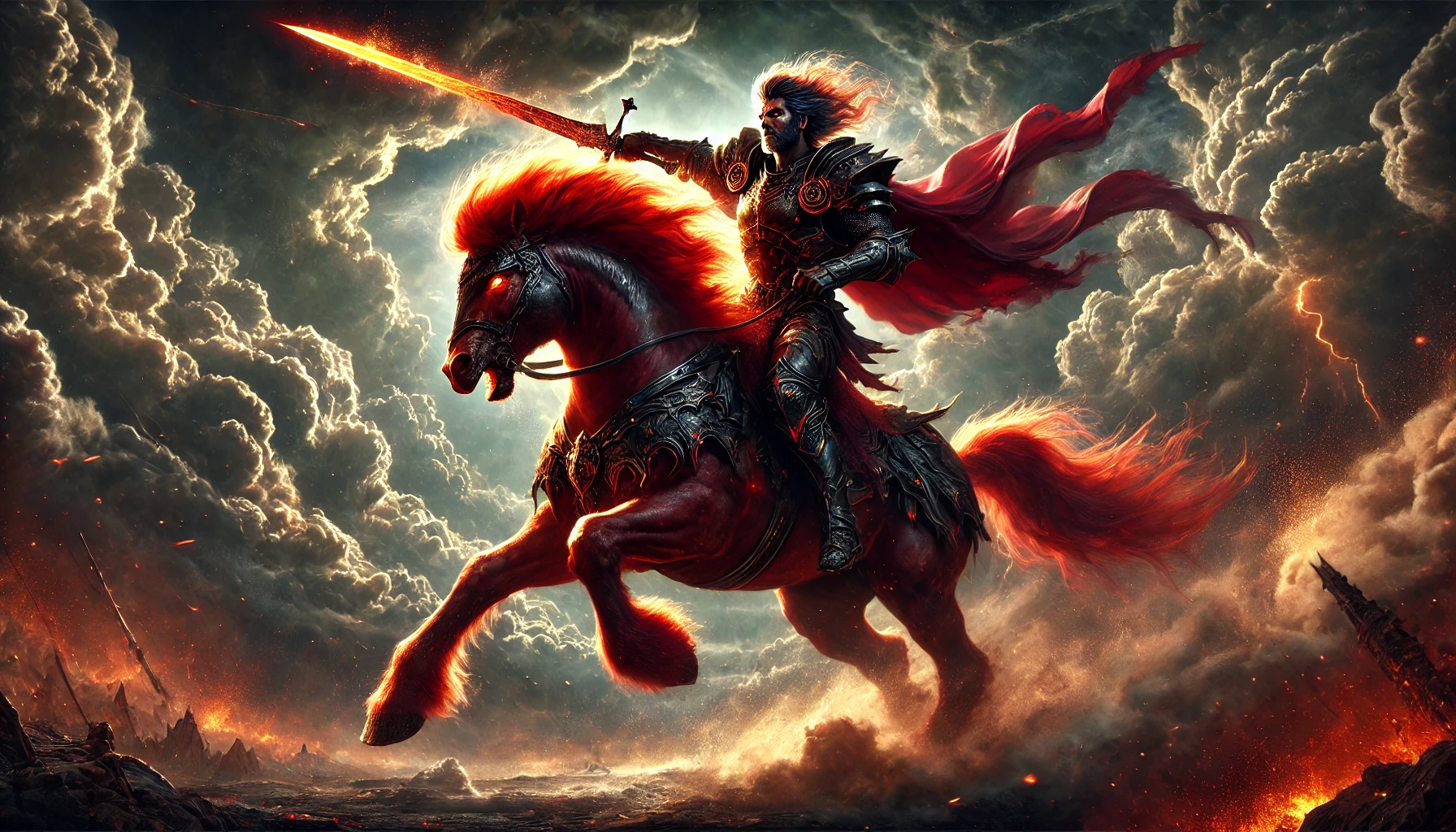
"And there went out another horse that was red: and power was given to him that sat thereon to take peace from the earth, and that they should kill one another: and there was given unto him a great sword."
(Revelation 6:4)
Red is the color of blood and of war. The second horseman's assignment is specific and sobering. He is given power to take peace from the earth. Not a single nation or region. The earth. And the result is that people kill one another on a scale that makes the word "war" feel inadequate.
The great sword he carries represents organized, large-scale military conflict. This is not terrorism or civil unrest, though those may accompany it. This is the kind of global warfare that reshapes borders, topples governments, and leaves entire regions unrecognizable. The world has had glimpses of this in the twentieth century. What the second horseman brings will be of a different order entirely.
What is worth noting is the sequence. The red horse follows the white. The work of the first horseman, the establishment of God's kingdom, the political disruption of deeply entrenched systems, does not happen peacefully. It provokes reaction. Forces that have operated in the shadows for generations will not yield their influence without resistance. The red horse is, in significant part, that resistance.
The Third Horseman: The Black Horse
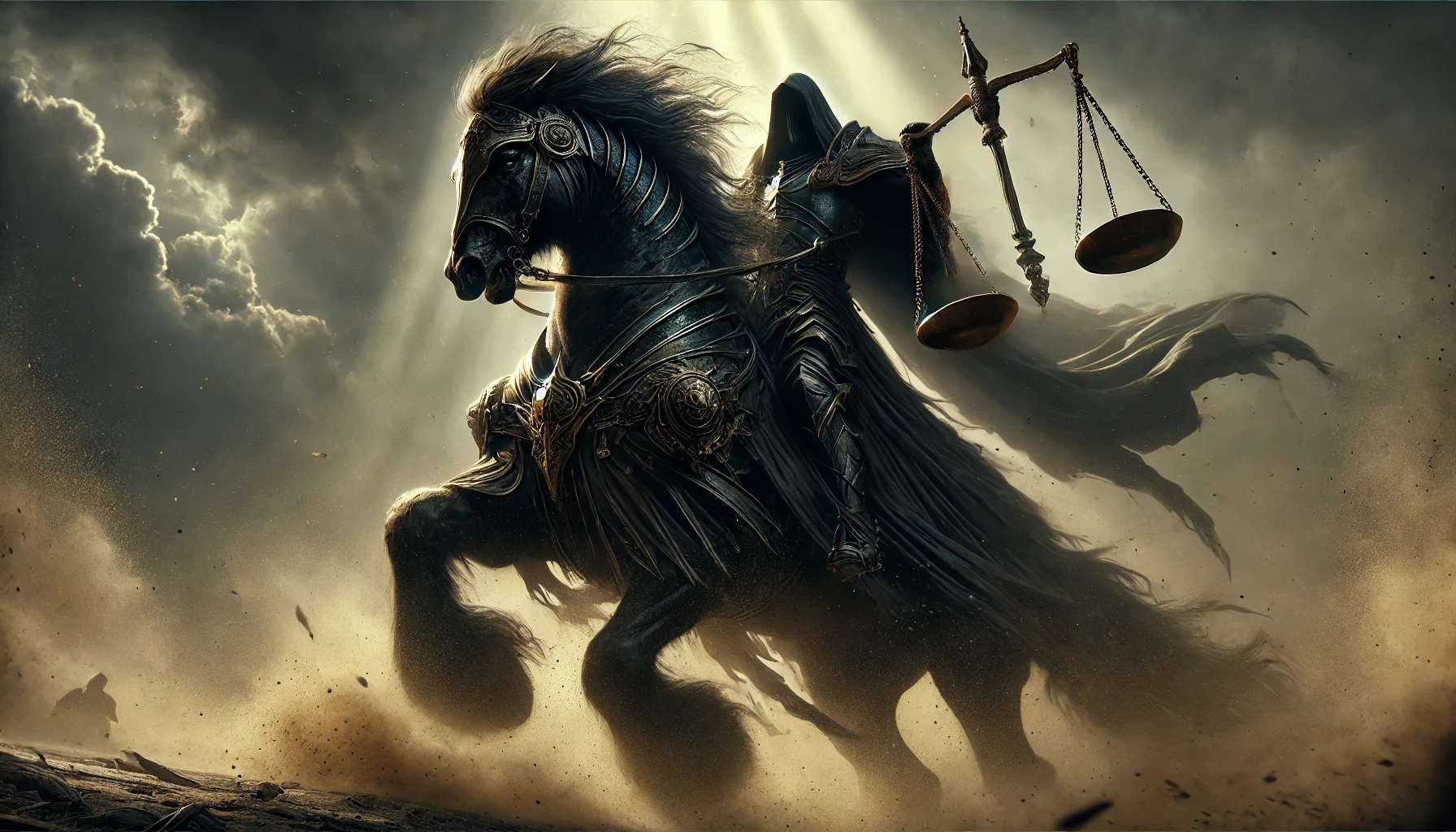
"And I beheld, and lo a black horse; and he that sat on him had a pair of balances in his hand. And I heard a voice in the midst of the four beasts say, A measure of wheat for a penny, and three measures of barley for a penny; and see thou hurt not the oil and the wine."
(Revelation 6:5–6)
Black represents famine, scarcity, and economic collapse. The third horseman carries a pair of balances, the ancient instrument of commerce and trade. And the voice that accompanies him announces the price of basic food: a day's wages for a single measure of grain. What would ordinarily be affordable has become catastrophically expensive.
This is an economic catastrophe. The global financial systems that billions of people depend on for their daily survival have broken down. Supply chains have failed. Currency has collapsed or been weaponized. The ordinary person is spending everything they have just to eat.
That final instruction — "hurt not the oil and the wine" — is easy to read past, but it carries one of the most significant promises in the entire passage. Throughout scripture, oil and wine carry deep covenantal meaning. They represent the sanctified, the consecrated, those who have been set apart and anointed by God. This is not a reference to luxury goods or the wealthy being spared. It is a declaration that there will be a covenant people who pass through the collapse of Babylon's economic system without being destroyed by it. The disasters poured out on the world's systems will not touch them — not because of wealth or political protection, but because of where they stand before God. I explored this in more depth in the article on Babylon the Great and the economic system behind the name.
If you want to understand what lies at the root of this kind of economic catastrophe and what the Lord's answer to it actually is, I have also written about the only economic system that has ever solved the wealth gap completely. The black horse is what happens when the world's systems finally exhaust themselves. What comes after is not more of the same.
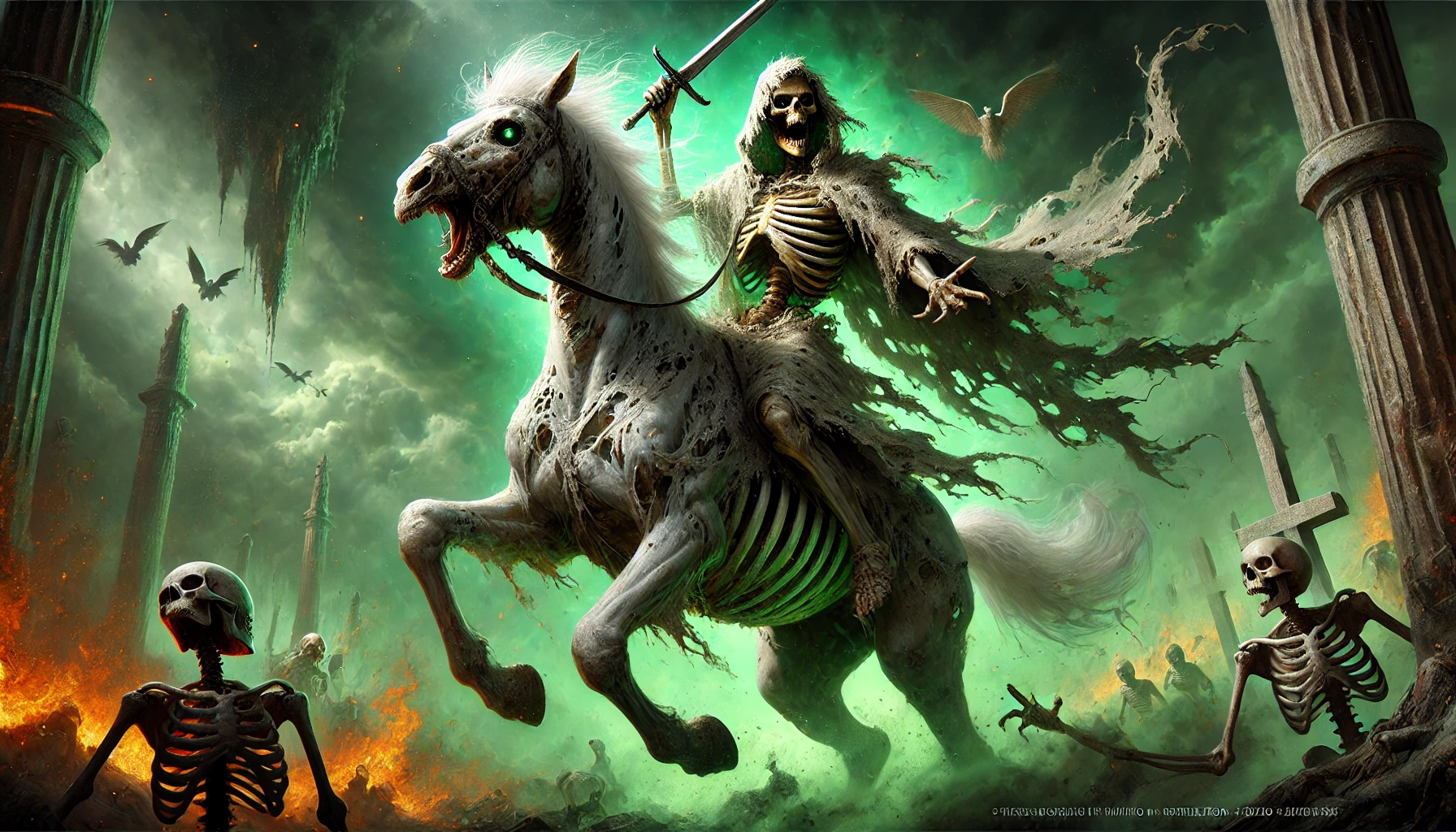
The Fourth Horseman: The Pale Horse
"And I looked, and behold a pale horse: and his name that sat on him was Death, and Hell followed with him. And power was given unto them over the fourth part of the earth, to kill with sword, and with hunger, and with death, and with the beasts of the earth."
(Revelation 6:8)
The fourth horseman is the most terrifying of them all, and John does not soften the description. His name is Death. Hell follows immediately behind him. And they are given power over a fourth part of the earth.
The pale horse carries the cumulative weight of everything that preceded it. War, famine, economic collapse, disease, and the violence of desperate people and desperate systems all converge. A quarter of the earth's population is within the scope of this rider's reach. The number is staggering. In a world of eight billion people, that is two billion souls.
The Greek word translated as "pale" is chloros, the same word used elsewhere for the color of sickly, dying vegetation. It is the color of a corpse. John is not being poetic here. He is being precise. This is what the end of one age looks like before the next one begins.
"His name that sat on him was Death, and Hell followed with him. John does not give the other horsemen names. Only this one. The choice is deliberate. This is the seal that gathers the consequences of every choice the world made when it rejected God's order."
What the Sequence Tells Us
The four horsemen are not random. They follow each other in a sequence that has its own internal logic. The white horse goes first. A divinely authorized servant is sent forth on a mission of conquest and kingdom building. That mission disrupts the existing order in ways that provoke the red horse: global conflict and the removal of peace from the earth. The resulting chaos breaks down the economic systems that sustain daily life, releasing the black horse of famine and scarcity. And all of that accumulating destruction converges in the pale horse, the gathering of war, hunger, disease, and death into one terrible moment.
This is not a description of something God causes because He is angry. It is a description of what happens when the world's systems, built on corruption and the love of power, finally collapse under their own weight. God does not send the horsemen to punish. He sends them because the time has come for one age to end and another to begin.
And the white horse going first is the key. Before the chaos, before the war, before the collapse, God sends His servant. The first horseman is not a harbinger of doom. He is the beginning of the answer. What he goes forth to establish, the political kingdom of God on the earth, is precisely what makes the transition from this age to the next one possible.
If you want to understand why this matters right now, and why I believe we are watching the white horse rider step into his role in our own generation, I would encourage you to read about the marred servant prophecy and whether Donald Trump appears in biblical prophecy. The evidence is more specific than most people expect, and the implications of getting this wrong are too significant to dismiss without a careful look.
The seals are opening. The riders are coming. The only question that matters is whether you understand what you are watching when they arrive.
Kelly Smith is the author of The First Horseman: Donald Trump and Biblical Prophecy. He is a lifelong student of biblical prophecy and a member of The Church of Jesus Christ of Latter-day Saints.